Sun Safety for Young Children in Maroubra: A Parent’s Summer Guide
Sun, heat and water. The three things that change for little ones when the clocks go forward, and what actually works for each, from the educators who apply sunscreen to a room full of toddlers every morning.
Daylight saving starts on Sunday 4 October. Afternoons get longer, the beach gets busier, and a lot of parents start asking us the same questions at pick up. How often should I really reapply sunscreen? Is a cap good enough? Can my baby wear sunscreen at all?
Here are straight answers, drawn from Cancer Council NSW, NSW Health and Royal Life Saving, with a few things we have learned from years of outdoor play in the Eastern Suburbs.
Quick answers
When does my child need sun protection? Whenever the UV Index is 3 or above, even on cool or cloudy days. The free SunSmart app shows the daily sun protection times for your suburb.
What sunscreen should I use on my child? SPF 30 or higher (Cancer Council recommends SPF 50 or higher), broad spectrum and water resistant. Apply 20 minutes before going outside and reapply every two hours.
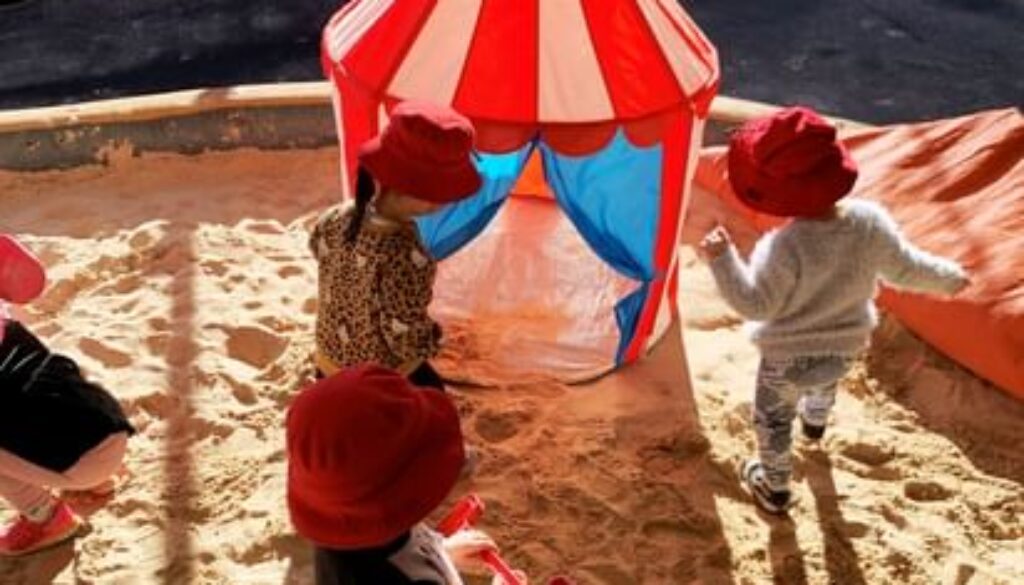
What is the best hat for a toddler? A broad brimmed, bucket or legionnaire hat that shades the face, ears and back of the neck. Caps do not protect the ears or neck.
Can babies wear sunscreen? Babies under 12 months should be kept out of direct sun when the UV is 3 or above. Sunscreen is not recommended for regular use under six months.
How do I keep a toddler safe near water? Stay within arm’s reach with your full attention whenever they are in, on or near water. Most drownings of children under five follow a fall into water, often a swimming pool.
Part one: the sun
When does my child need sun protection?
This is the single most useful thing to know. A cool, cloudy, breezy day at Maroubra can still have high UV. Cancer Council NSW advises sun protection whenever the UV Index is 3 or above, and on extreme UV days unprotected skin can burn in as little as 11 minutes.
You do not need to guess. The free SunSmart app shows the sun protection times for your exact location each day. It takes about five seconds to check before you head out.
Why does sun protection matter so much for young children?
Children’s skin is thinner and more easily damaged, and sun exposure in the early years adds to lifetime skin cancer risk. Australia has one of the highest skin cancer rates in the world. The good news is that the habits children learn now, reaching for a hat on the way out the door, tend to stay with them.
Sun safety for children: the five steps
| Step | What it looks like for a young child |
|---|---|
| Slip on clothing | Loose fitting clothes in tightly woven fabric. Tops with sleeves and a collar cover far more than a singlet. |
| Slop on sunscreen | SPF 30 or higher, broad spectrum and water resistant (Cancer Council recommends SPF 50 or higher for families). Apply 20 minutes before going out and reapply every two hours, or sooner after water, sand or a sweaty play session. |
| Slap on a hat | Broad brimmed, bucket or legionnaire style, covering the face, ears and back of the neck. Caps leave the ears and neck exposed. |
| Seek shade | Use it as much as possible, but remember UV bounces off sand, water and concrete, so shade alone is not enough. |
| Slide on sunglasses | Close fitting, wraparound, meeting the Australian Standard. Worth trying if your child will keep them on. |
Can babies wear sunscreen?
Cancer Council NSW recommends babies under 12 months are kept out of direct sun when the UV is 3 or above. That means shade, a pram canopy, and covering clothing, rather than relying on sunscreen.
Sunscreen is not recommended for regular use on babies under six months, because their skin absorbs more. If sun exposure cannot be avoided, apply a small amount to small exposed areas only.
How do I get sunscreen on a toddler who won’t sit still?
Getting sunscreen onto a wriggling two year old. What works in our rooms: make it part of the routine, not a negotiation. Same time, same place, every day, before shoes go on. Let them do a bit themselves (“you do your knees, I’ll do your ears”). A roll on or stick is often easier on faces than a lotion. And children copy adults, so let them see you do yours too.
Part two: the heat
Babies and young children heat up faster than adults and cannot always tell you they are thirsty. NSW Health’s advice:
- Offer water often. Water should be the main drink for older children. Breastfed babies do not need extra water; formula fed babies may need more feeds.
- Never leave a child alone in a car, whatever the weather. Even on mild days, cars heat up fast.
- Do not drape a dry blanket or wrap over the pram. It traps heat and restricts airflow. Use the canopy, and if you want extra cover, a damp muslin that lets air flow through.
- Plan outings for cooler parts of the day and dress children in light, loose clothing.
What are the signs of heat illness in young children?
Mild dehydration looks like fewer wet nappies, darker wee, and a dry mouth. Signs that need urgent help include a child who looks unwell, is unusually irritable or drowsy, floppy, pale, confused, or refusing to drink. For those, call 000. If you are worried but it seems mild, call your GP or healthdirect on 1800 022 222.
And if your child is unwell after a hot day, our guide When is my child too sick for daycare? covers when to keep them home.
Part three: the water
This is the part we would ask every Maroubra family to read twice.
Drowning remains a leading cause of preventable death for young children in Australia. In 2024 to 2025, Royal Life Saving recorded 15 drowning deaths of children aged 0 to 4. One year olds were the most at risk, and more than half of these deaths followed a fall into water, most often in a swimming pool. That is a child who wandered off, not a child who was swimming.
Royal Life Saving’s Keep Watch program gives four actions:
- Supervise. For young children, that means within arm’s reach, with your full attention, every time they are in, on or near water. Not scrolling, not chatting, not “just ducking inside”.
- Restrict access. Pool gates closed and never propped open. Buckets, paddling pools and baths emptied straight after use.
- Teach water skills. Swimming lessons build familiarity and confidence, but they do not make a young child water safe on their own.
- Learn to respond. A CPR course is one of the most useful few hours a parent can spend.
How does MJEEC keep children sun safe?
Every NSW early learning service must have a sun protection policy, and outdoor spaces must include adequate shade. At MJEEC, sunscreen and hats are included in the daily fee, so you do not need to pack either. Our educators apply sunscreen before outdoor play and reapply through the day, and children learn the routine alongside their friends.
Two things that help us: apply sunscreen at home before drop off on warm mornings, and dress your child in tops with sleeves where you can. If your child has sensitive skin or a reaction to a particular sunscreen, tell us in writing and we will work out an alternative with you.
Questions about our outdoor program?
Come and see our outdoor spaces for yourself. Book a tour, or call us on (02) 9315 5588.
More from our Parent Hub: When is my child too sick for daycare? · Childcare in Maroubra: the questions parents ask us most
About the author: Lauren Ziegler is the Director and Nominated Supervisor of Maroubra Junction Early Education Centre, with a Bachelor of Education (Early Childhood), two diplomas in early childhood education and more than 30 years in the sector. Last reviewed September 2026.
Sources: Cancer Council NSW, When is sun protection needed and Sun protection for babies and children; Cancer Council NSW SunSmart Program for Childcare Services; NSW Health, Babies and young children in hot weather; Royal Life Saving Society Australia, National Drowning Report 2025 and Keep Watch Actions. This article is general information, not medical advice. Please speak to your GP about your child’s individual needs.