Is Preschool Just Play? What Children Actually Learn Through Play-Based Learning
Quick answer: No. Play is how young children learn best, and in a good preschool it is planned on purpose. While children build, pretend, paint and argue over whose turn it is, they are practising early maths, language, problem solving and getting along with others, the same skills that make the first year of school easier. Australia’s national curriculum for under fives, the Early Years Learning Framework, is built around learning through play.
Key points
- Play-based learning is the approach required by Australia’s Early Years Learning Framework, not a soft option.
- The difference between play and play-based learning is the educator: what they set up, when they join in and what they notice.
- Block play, pretend play, art, outdoor play and everyday routines each build specific skills for school and life.
- You can see the learning behind the play in your child’s learning journal, and by asking what they were curious about today.
Is preschool just play?
It is one of the questions we hear most on tours, usually from a parent who is quietly worried their child should be doing worksheets by now. It is a fair question. From the doorway, a preschool room can look like a lot of fun and not much work.
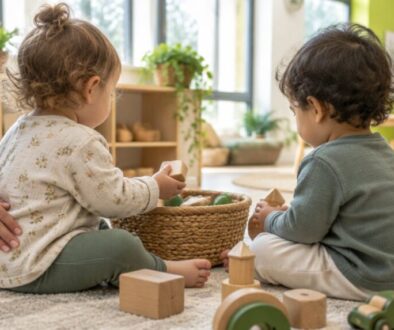
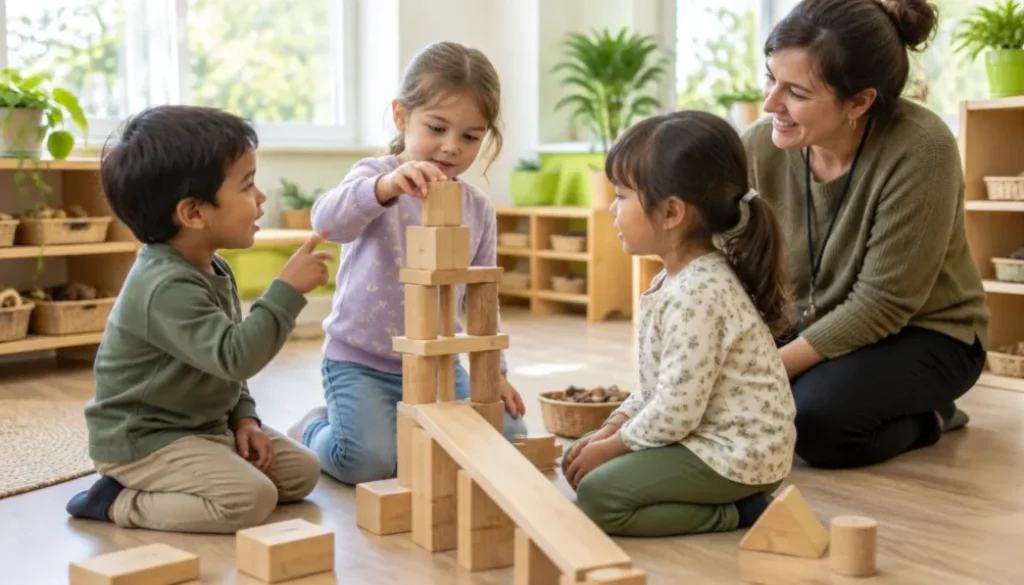
Look closer and you will see children counting how many cups the tea party needs, negotiating who gets to be the shopkeeper, working out why the ramp keeps collapsing and telling a friend a long story about a dragon. That is the work. Young children learn best by doing, talking and trying again, and play gives them a reason to do all three.
What is play-based learning?
Play-based learning means children learn through play that educators have thought about carefully. The Early Years Learning Framework, the national curriculum for children before school, asks educators to be intentional: “deliberate, purposeful and thoughtful in their decisions and actions”.
In practice, that means an educator who knows a child is ready to start counting beyond ten might set up a shop with prices on the shelves. A child who struggles to join a group might be invited to help carry the big blocks. The child experiences play. The educator is teaching.
Sometimes intentional teaching means stepping in with a question or a new idea. Often it means stepping back and letting a game run, because the children are solving the problem themselves.
What do children actually learn through play?
Here is what is happening underneath some of the most common kinds of play in a preschool room.
- Block and construction play: counting, measuring, shapes, balance, cause and effect, and planning (“if we make the bottom wider, will it stay up?”).
- Pretend play: language, storytelling, taking turns, seeing things from someone else’s point of view and managing big feelings when the game does not go their way.
- Art, music and craft: fine motor control for holding a pencil, creativity, patterns and rhythm, and the confidence to try something new.
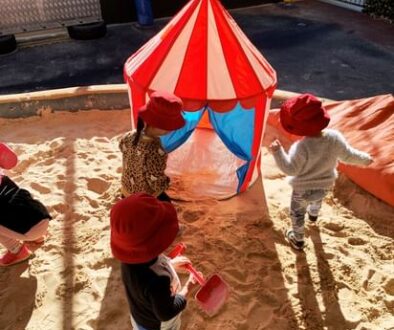
- Sand, water and outdoor play: early science (what floats, what pours faster), gross motor skills, coordination and safe risk-taking.
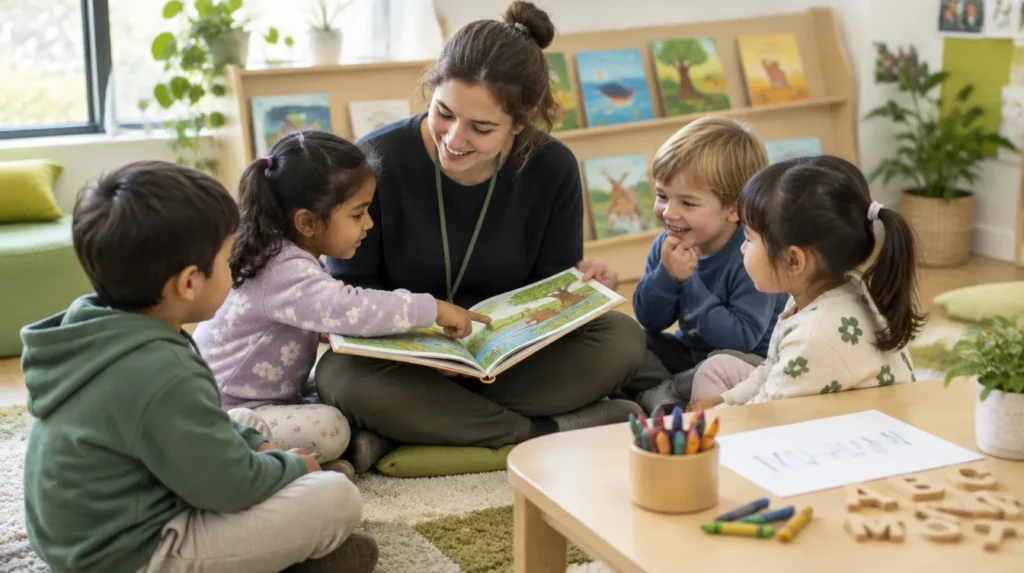
- Stories, songs and rhymes: listening, new words, hearing the sounds inside words, and the foundations of reading.
- Routines like meals and packing away: independence, following a sequence, looking after belongings and caring for the group.
How does play link to the Early Years Learning Framework?
The framework (V2.0, 2022) sets out five learning outcomes for children before school. Every one of them is built through play:
- Children have a strong sense of identity.
- Children are connected with and contribute to their world.
- Children have a strong sense of wellbeing.
- Children are confident and involved learners.
- Children are effective communicators.
When we plan the program, we start from the children: what they are interested in, what they have been talking about and what each child is ready to learn next. Then we plan experiences that link those interests to the outcomes.
How does this work in our Maroubra preschool rooms?
At MJEEC, our school readiness program runs over two years. In Preschool 1, for three to four year olds, play is where confidence, friendships and early literacy and numeracy grow. In Preschool 2, the year before school, play becomes more complex and children take on more responsibility, with a routine that looks a little more like a school day.
We ask ourselves three questions when we plan: whose interests are we following, who might be missing out, and what assumption did we make? It keeps the program centred on the children in the room, not a generic plan.
Families receive learning journal entries that show what was planned, what the children actually said and did, and what we added on the day. It is the best way to see the learning inside the play. You can read more about the program on our preschool in Maroubra page.
How can I support play-based learning at home?
- Ask open questions. “What did you build today?” or “What was the tricky part?” gets far more than “What did you learn?”
- Keep simple materials handy. Blocks, boxes, paper, crayons, playdough and dress-ups do more than most toys with batteries.
- Let them struggle a little. Waiting a moment before you fix the tower teaches persistence.
- Read together every day. Talk about the pictures and guess what happens next.
- Bring in real jobs. Setting the table, sorting socks and helping with shopping are maths and responsibility in disguise.
If you are thinking about the year before school, our guide to signs of school readiness covers what teachers are really hoping for.
Frequently asked questions
Is play-based learning enough to get my child ready for school?
For most children, yes. Schools are not expecting children to arrive reading. They are hoping for children who can concentrate, follow a routine, manage their feelings, ask for help and get along with others. Those skills are built through play, with educators who know what each child is working on next.
Do children learn to read and write at preschool?
Children learn the foundations: listening, talking, rhyming, noticing letters and sounds, holding a pencil and wanting to make marks that mean something. Many children begin writing their name in the year before school. Formal reading and writing are taught at school.
What is the difference between play-based learning and free play?
Free play is children choosing what to do. Play-based learning adds an educator who has thought about the space, the materials and what each child is ready to learn, then joins the play, asks questions or stays back, depending on what will help most.
How will I know what my child is learning?
Ask to see their learning documentation. At MJEEC, families receive learning journal entries that describe what was planned, what the children said and did, and what happened next, so you can see the learning behind the play.
Is there a set curriculum in long day care preschool rooms?
Yes. Approved services in Australia must base their program on an approved learning framework. For children before school, that is the Early Years Learning Framework (V2.0, 2022), which sets out five learning outcomes for children.
Want to see play-based learning in action? Come and visit our preschool rooms, ideally in the morning when the program is in full swing. Book a tour with Lauren.